How to Record a Motion and Vote in HOA Board Minutes
This guide is general information for volunteer board members, not legal advice. Statutes change; read your own state's current text and your association's governing documents, and consult your association's attorney for specific situations.
Most HOA board meetings do not go wrong during the debate. They go wrong in the ten seconds after it, when someone says "okay, so we're all good with the roof thing?" and the room nods. Six weeks later nobody can say what was approved, who was authorized to sign, what the spending ceiling was, or which directors voted for it.
The motion is the fix. A motion is the only mechanism that converts board discussion into a decision the association can actually act on and defend. And a motion only does that job if three things happen: it is drafted before the meeting, it is voted on as written, and it is recorded in the minutes word for word alongside the vote.
This guide covers all three, plus the step most boards skip entirely — turning the approved motion into a tracked action item with a name and a date on it.
Draft the motion before the meeting, not during it
Motions composed live, out loud, in front of eight people are the single largest source of vague minutes. The mover starts with "I move that we, uh, get the landscaping handled," the board amends it three times verbally, and the secretary writes down whatever they managed to catch.
The alternative costs about five minutes of prep. Whoever is bringing a decision to the board writes the motion out in full and sends it with the agenda packet. That gives you four things at once:
- Directors read it before they vote. Nobody is parsing a $40,000 commitment for the first time while it's being read aloud.
- The secretary has the exact text. The motion goes into the minutes by copy and paste, not by memory.
- Gaps surface early. Writing "not to exceed $____" forces somebody to go get the actual bid before the meeting.
- The agenda stays legal. In some states the board can only act on items that were noticed. California is the strict example: under Civil Code section 4930, the board generally may not discuss or take action on an item at a nonemergency meeting unless the item was on the agenda distributed with the notice. A pre-drafted motion makes it obvious whether the item is properly noticed.
A practical convention: put pre-drafted motions in the packet in a distinct block labeled Proposed Motions, each tied to its agenda item number. Board members learn quickly to read that page first.
What an effective motion actually contains
A motion that can be implemented without a follow-up phone call answers five questions on its face: what, how much, who, by when, and under what conditions.
The reliable structure:
"I move that the Board [action verb] [specific subject] [dollar ceiling] [responsible party] [deadline] [funding source and conditions]."
Use verbs that authorize something: approve, adopt, authorize, direct, ratify, retain, reject. Avoid verbs that authorize nothing: consider, discuss, look into, address, explore. "I move that the Board look into the drainage problem" is not a decision; it is a conversation with a vote attached.
Weak versus workable
Weak: "I move to approve the roof repairs."
Workable: "I move that the Board authorize the manager to execute the Summit Roofing proposal dated March 3 for replacement of the Building C roof at a cost not to exceed $46,800, funded from the reserve account, with work substantially complete by August 31, and that the Board President be authorized to approve change orders up to five percent of the contract amount."
That second version is longer to read and shorter to argue about. Every number a future board, auditor, or attorney would ask for is inside the motion.
One subject per motion
Do not bundle. "I move to approve the reserve study, raise dues 4 percent, and hire the new landscaper" forces a director who supports two of the three into an all-or- nothing vote and produces a minute entry nobody can interpret. Split it into three motions and take three votes. If you have already started debating a compound motion, the clean recovery is a motion to divide the question.
Confirm the board actually has the authority
Before the motion reaches the floor, check that the action is inside the board's power. Special assessments, dues increases above a stated cap, and amendments to the declaration commonly require a membership vote rather than a board vote. A motion the board had no authority to pass is worse than no motion — it looks like a decision, and people rely on it. Our state-law guides cover where those lines fall in Florida, Washington, and California.
Running the vote so it can be recorded cleanly
The chair's job here is narrow and mechanical. Under Robert's Rules as most HOAs apply it, the sequence is:
- Motion. A director moves it — ideally by reading the pre-drafted text or saying "I move the motion as written in the packet under item 6."
- Second. No second, no motion. It dies without discussion.
- Chair restates the motion. This is the step boards skip and the one that saves the minutes. The chair reads the motion as it will be voted on, including any amendments adopted during debate.
- Debate. On the motion, not on adjacent grievances.
- Amendments handled as their own motions. Each amendment is moved, seconded, and voted before the main motion. The secretary records the final amended text, not the sequence of failed wordings.
- Vote. The chair calls it and states the result out loud: "Four in favor, one opposed, none abstaining. The motion carries."
Two mechanics worth standardizing:
Call for abstentions explicitly. "Any abstentions?" takes two seconds and it matters, because an abstention that never gets stated tends to get recorded as a yes. Washington makes the stakes concrete: under RCW 64.90.445(2)(j), a board member present when action is taken is presumed to have assented unless their dissent or abstention is lodged with the person acting as secretary before adjournment, or provided to the secretary in a record immediately after adjournment. A director who sat silent is on record as a yes.
Use roll call for remote meetings and close votes. Washington requires it for conferenced meetings outright: RCW 64.90.445(3)(c) provides that any votes of the board members in a telephonic or video meeting must be conducted by roll call or other verbal vote. On a Zoom call, a show of hands is not a record. Roll call also produces the per-director detail that some states require in the minutes anyway.
Note that a final vote does not belong in executive session. Washington states it flatly in RCW 64.90.445(2)(a): a final vote or action may not be taken during an executive session. The general practice everywhere is to discuss the sensitive matter privately, then return to open session and take the vote there — with the motion worded so it does not disclose what should stay confidential. See executive session minutes for how to document that split.
Recording the motion and vote in the minutes
Minutes are a record of decisions, not a transcript of the discussion. The motion entry is where that principle earns its keep. Every motion should appear in the minutes with five elements:
- The exact wording of the motion as voted, in quotation marks.
- Who moved it.
- Who seconded it.
- The vote — counts at minimum, per-director where required or where the vote was not unanimous.
- The outcome: carried, failed, tabled, or withdrawn.
A model minute entry
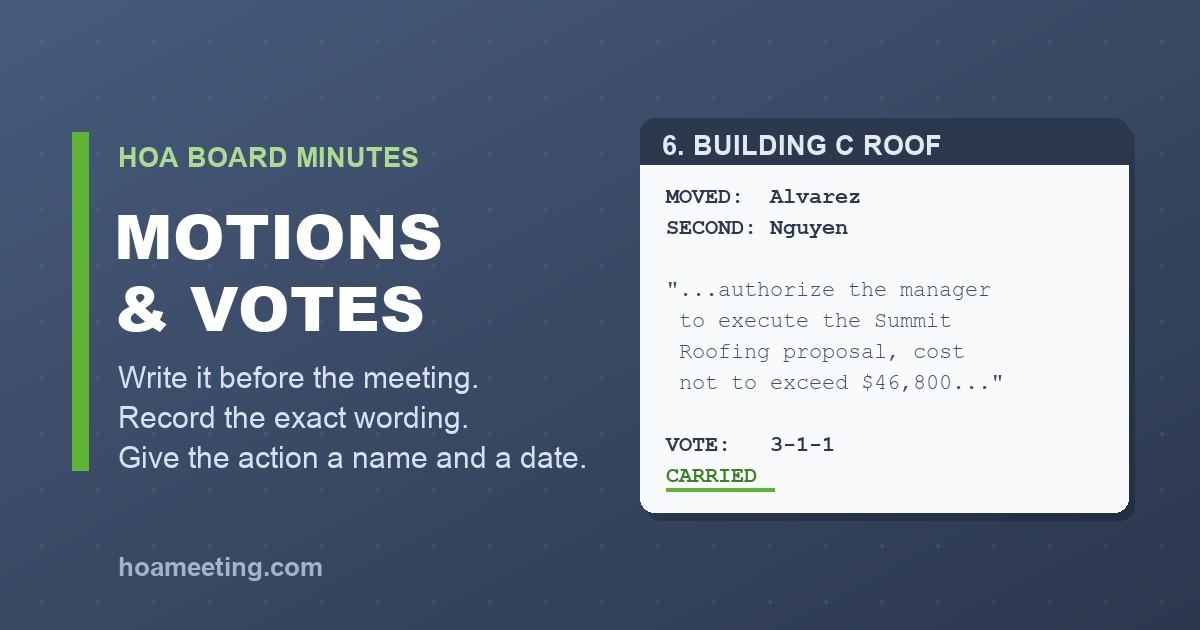
6. Building C Roof Replacement
Director Alvarez moved: "That the Board authorize the manager to execute the Summit
Roofing proposal dated March 3 for replacement of the Building C roof at a cost not to
exceed $46,800, funded from the reserve account, with work substantially complete by
August 31." Seconded by Director Nguyen. Discussion addressed the two competing bids and
the reserve balance after the draw. Vote: Alvarez aye, Nguyen aye, Patel aye, Brooks
nay, Whitfield abstained. Motion carried 3-1-1. Action: Manager to execute the contract
and confirm the start date to the Board by April 15.
That entry is roughly ninety words and it answers every question a future board, buyer, auditor, or attorney will ask about the decision. Compare it to what most minutes contain: "The Board discussed the roof and agreed to move forward."
How much vote detail your state requires
The floor varies, and it is worth knowing yours before you decide that vote counts are enough.
- Florida (HOAs): Fla. Stat. 720.303(3) requires that a vote or abstention from voting on each matter voted upon for each director present at a board meeting be recorded in the minutes. Per-director detail is not optional — a bare "motion carried unanimously" does not satisfy the statute on its face.
- Washington (WUCIOA): RCW 64.90.445(4) requires minutes of all unit owner and board meetings, excluding executive sessions, to be maintained in a record, and the decision on each matter voted upon to be recorded in the minutes. The statute requires the decision; combined with the assent presumption in subsection (2)(j), recording individual positions is the defensible practice.
- California: Civil Code section 4950 requires that minutes, proposed draft minutes, or a summary of the minutes of any board meeting other than executive session be available to members within 30 days of the meeting. The exposure here is timing as much as content — whatever you record is going to owners inside a month.
Practical rule that satisfies all three: record per-director votes on every motion that isn't unanimous, and on any motion involving money, contracts, assessments, or enforcement regardless of the margin. It costs one extra line.
Record failed motions too
A motion that fails is a board decision. Leaving it out of the minutes creates the impression the matter was never considered, which is exactly the wrong record when an owner later asks why the board did nothing about a known problem. "Motion failed 2-3" is a complete and useful entry.
For the full nine-item checklist of what belongs in a set of minutes, see what to include in HOA meeting minutes.
The step most boards skip: the action that comes out of the motion
A passed motion is an instruction to somebody. If the minutes stop at "motion carried," the instruction has no owner and no deadline, and the board spends the first fifteen minutes of the next meeting reconstructing what happened.
Close the loop with two habits.
1. Every passed motion generates an action item with a name and a date. Not "the Board will follow up" — a person and a calendar date. Where the motion itself names the responsible party and deadline (as the model motion above does), the action item writes itself.
2. Carry an open action items list forward in every packet. A simple four-column table: item, owner, due date, status, plus the date and motion it came from. Review it as a standing agenda item near the top of the meeting. Items that keep slipping become visible in one glance instead of one year.
Something worth telling your board out loud: an action item is not a license to change the deal. If the contractor comes back at $52,000 on a motion capped at $46,800, that is a new motion, not a judgment call. The cap in the motion is the board's authority, and exceeding it is exactly the sort of thing that gets litigated. Build the tolerance into the original motion — a change-order allowance, as in the model above — if you expect movement.
Then get the minutes approved
The motion record isn't final until the minutes are. Minutes are a draft until the board formally approves them, usually at the next meeting, and the approval itself happens by motion: "I move to approve the minutes of the March 12 regular meeting as presented" — or "as corrected," with the corrections described. Corrections change the record of what was written, not the decision that was made; you cannot amend minutes to undo a vote. Our guide to approving HOA meeting minutes walks the mechanics.
A pre-meeting motion checklist
Before any motion goes into the packet, confirm:
- The action verb authorizes something specific.
- There is a dollar ceiling, not an estimate.
- The funding source is named — operating or reserve.
- A responsible party is named.
- There is a deadline or effective date.
- It covers one subject.
- The matching agenda item is properly noticed.
- The board has authority to take this action without a membership vote.
- The secretary has the text in writing, ready to paste into the minutes.
If you want a starting structure for the minutes themselves — including the motion and vote block — our free HOA meeting minutes template is set up for copy and paste. For more on composing the motion language itself, see how to write an effective board motion.
None of this requires a parliamentarian. Write the motion down before the meeting, make the chair restate it before the vote, call for abstentions, record the exact wording with the vote, and give the resulting action a name and a date. Five habits, and your minutes stop being the weakest document your association owns.
Related articles
A.R.S. 33-1804: Arizona HOA Board Meetings — 48-Hour Notice, the Five Executive Session Grounds, and the New Ban on Closed-Session Votes
A.R.S. 33-1804: Arizona HOA board meetings are open, notice and agenda run 48 hours ahead, and from Sept. 12, 2026 no board may vote in closed session.
Executive Session Under RCW 64.90.445(2)(b): The Five Grounds, and What a Washington Board Can't Do Behind the Door
RCW 64.90.445(2)(b): the five executive session grounds a Washington HOA board may use, why no vote may be taken there, and what the minutes must show.
No, You Don't Have to Sit in Silence for 15 Minutes — RCW 64.90.445(2)(e) Explained
RCW 64.90.445(2)(e) explained: the 15 minutes is reserved time, not a silence timer. The 90-second floor, the 10-owner exception, and what goes in minutes.